Friday, 28 February 2020

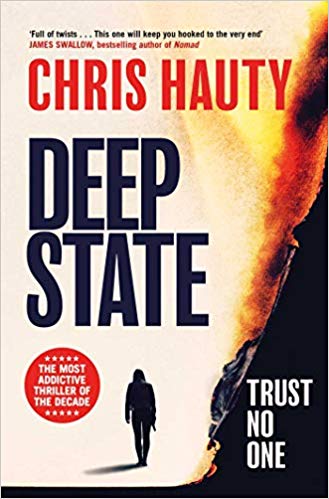
Deep State by Chris Hauty


As someone with a great interest in politics and current affairs, I’ve found the popularisation of the term “deep state” fascinating. Originally, the term was unique to Turkey, where the nation’s military and intelligence apparatus held sway and often exerted a malign influence on events. The term didn’t really spread from there until Donald Trump ran for the Presidency of the United States in 2016, whereby his supporters, particular Steve Bannon and his colleagues at Breitbart, began to claim that there was a US deep state that was hellbent on frustrating Trump’s agenda. Since then, and despite the fact that Bannon is reported to have told people that claims of a deep state in the US are in fact bogus, the notion has caught on. The idea of a deep state has also entered the lexicon and has been claimed for other countries too, some with more validity than others.

This is all background information of course, and is not necessarily needed when reading such a novel as this, but it’s interesting nonetheless to contemplate how a concept went from regional specificity (Turkey), through conspiracy theory (Trump and his allies' allegations against their opponents), through legitimate analysis (examinations of other countries, such as former Soviet republics, that might indeed have a deep state), and finally to popular fiction.

For the notion of a deep state has indeed now firmly supplanted itself in the fictional universe. There’s a FOX drama series titled Deep State which stars Mark Strong. There are a number of other novels, TV shows and films which play with the concept. And now there’s this novel by Chris Hauty. 

When the White House Chief of Staff is found dead, supposedly of a heart attack, his intern, Hayley Chill, suspects foul play. Everyone fobs Hayley off and dismisses her concerns, but when she perseveres, she discovers an organisation buried deep in the government and a plot to assassinate the President. 

Chris Hauty is a screenwriter by trade, and it shows, in that this is a very filmic novel. One can easily imagine it adapted for the big screen. This is a high-octane novel and is well plotted and has twists galore.

An enjoyable read and certainly a page turner

3 out of 5 stars 

Thursday, 27 February 2020

The Aosawa Murders by Riku Onda


There have been a number of homicidal mass poisonings in Japanese history – The Teigin Incident in 1948, where a man posing as an epidemiologist persuaded the employees and patrons of a bank to drink an “inoculation against dysentery”, which in reality was cyanide; The Sonobe Incident of 1965, where a woman poisoned a communal pot of curry prepared for a summer festival with arsenic; The Paraquat Murders in 1985, a series of indiscriminate murders where someone unknown (the perpetrator was never found) killed twelve people and injured thirty five, by lacing beverages in vending machines; the Tokyo Subway Sarin attack of 1995, not strictly a poisoning of course, but the Aum Shinrikyo cult’s release of sarin gas on the Tokyo subway has at least some similarities.

Japan isn’t unique in this, there have been such events in other countries, but in the popular culture of Japan (and Western writers writing about Japan) these incidents have certainly left their mark. David Peace fictionalised The Teigin Incident in his novel Occupied City, while the case also featured in Ian Fleming’s eleventh James Bond novel, You Only Live Twice. While an event in Nicolás Obregón’s latest novel, Unknown Male, bears similarities to The Sonobe Incident.

The Aosawa Murders is a Japanese novel, written by Japanese author Riku Onda, and is also centred on a mass poisoning event. The Aosawas are a prominent family in a provincial Japanese city. They own a medical clinic and generations of the family have treated local people’s ailments. The house they live in adjoins the clinic, and the combined clinic and Aosawa living quarters are a local landmark, combining as they do Japanese and Western architecture. One day, when hosting a large birthday celebration, drinks are delivered to the party which have been tampered with poison. Seventeen people die and there are just two survivors: a housekeeper and the Aosawa’s blind daughter. The investigation flounders and when the only suspect - a loner unconnected with the family and with mental health problems – commits suicide, it looks like the case will never be satisfactorily solved.  

This novel slowly and painstakingly expounds the events of the crime, its build up and aftermath, through a series of different writing styles: some chapters are in a semi-interview style, a conversation where we only read one side, the interviewees; a few others are in the style of newspaper clippings and excerpts. Slowly, we learn the truth of what happened and our questions are answered: Was the loner really guilty of the crime, and if so, did he have help? What role did Hisako Aosawa, the Aosawa’s surviving daughter, have in the affair?

The Aosawa Murders is a slow burn novel, but it is a very compelling read. This novel was winner of the Mystery Writers of Japan Award for Fiction and I can well see why.

A great find, this is a 5-star read

5 out of 5 stars

Monday, 10 February 2020

Death Deserved by Jørn Lier Horst and Thomas Enger


This is a new police procedural series written by a collaborating writing team consisting of two, well established names in Nordic noir. I’ve read a number of novels by Thomas Enger and they’ve always been very good. Perhaps surprisingly, I’ve never read a book by Jørn Lier Horst.

A prologue which details a disastrous police operation sets up one of the main characters, damaged police officer Alexander Blix, who’s career, and mental state is unduly affected by the outcome. The other main character is celebrity blogger Emma Ramm. In today’s world Emma happens upon the scene of a celebrity’s disappearance, all indications being that it’s through foul play. Blix is put on the police investigation into the case and the two are soon more or less working together. They soon discover that this is the start of a series of events that indicate that a serial killer is targeting celebrities and the famous, and that's when things get truly interesting. 

This is a well plotted novel that tackles various concerns of the moment, not least celebrity and our fame-obsessed culture. It is a good, solid police procedural, with plenty of twists and turns. The characters are well-developed, and while this is especially so for Blix and Ramm, it’s also true for the supporting cast. The authors make a good team.

A solid take on the police procedural, this is the start of a new series and fans of the genre could do much worse than get in at the start with this, the first book.

3 out of 5 stars

Sunday, 2 February 2020

Beast by Matt Wesolowski


This is the fourth novel in the author’s Six Stories series and once again we’re with podcaster Scott King as he investigates a mysterious event over six episodes, in each one speaking to someone with a different perspective of what occurred. 

King has journeyed to the small town of Ergath on the north east coast of England, to investigate the grisly murder of Elizabeth Barton, a beauty and lifestyle YouTube vlogger. Elizabeth was participating in a viral internet challenge, the Dead in Six Days challenge, where participants were set a dare by a vampire. They had to do the dare and then pass it on, or the vampire would own their soul. But Elizabeth refused to pass on the dare, wanting to do each dare herself until the sixth day when she would supposedly meet the vampire herself. 

Ergath has a local legend of its own vampire, supposedly brought to the town during the Crimean War and imprisoned in a tower, the ruins of which still stand on the seafront. Elizabeth’s involvement in the Dead in Six Days challenge takes place to the backdrop of the town’s mythology and occurs during the Beast from The East – the frozen weather front which came in from Siberia in 2018 and froze sections of the UK. Each of the dares that Elizabeth is set during the challenge becomes a little more extreme until she is meant to meet the vampire in the tower. It is here that she is locked inside by three local young men, dies of hypothermia, and then one of them beheads her.

Throughout King’s investigation it is never really in doubt who killed Elizabeth Barton. The evidence against her killers is overwhelming. But the questions that King wants to discover is why they killed her, and if possible, the men’s differing levels of culpability. To do this, he is soon looking into both killers and victim and discovering that not everything is what it seems. The story has always been that Elizabeth was a beautiful, popular, and kind person involved in charity work; her killers’ oddballs and loners. That Elizabeth’s killers murdered her at least in part due to jealousy (the other reason being that one of them believed her to be a vampire). But King soon finds other perspectives, that Elizabeth had secrets and that the killers were not the cardboard cut-out villains they had been portrayed.

Beast is a complex novel. There are elements of horror with the legend of the vampire, but that is not what this novel is really about. Rather, Beast is about social media, the pressure to conform, the pile in and witch-hunts that can occur on social media platforms, the challenges and games people can play on social media (and how sometimes these are hyped up in press scare stories). It is also about small towns hollowed out by deindustrialisation, and how the poverty and lack of services that plague such places can lead people to spiral out of control.  

This is a great read and the Six Stories series continues to impress.

5 out of 5 stars

Friday, 31 January 2020

Alec Marsh Q&A


Rule Britannia is your debut novel (which people can but here if they haven't already:  https://www.amazon.co.uk/Rule-Britannia-Alec-Marsh/dp/1786157187, and they really should, as it's very good). Some writers get published with their first attempt at a novel (even if it takes years of changes) others have aborted previous attempts. Was Rule Britannia the first novel you tried to write? Do you have unpublished novels that have never seen the light of day?

think I have three other unpublished novels lurking on various hard drives and floppy discs dating back 24 years or so, plus half a dozen short stories and about three plays. Two of the novels were written before Rule Britannia, and one written since. Actually… In fact, its now four novels, because I’ve also just written a sequel to Rule Britannia which is due to be published this October.


How many drafts did Rule Britannia go through? How long did it take you to write the book?

It took ages. But then I’d never written anything like this before. I think the idea first bobbed up into my head in about 2005. I then spent a long time writing it and finding my characters and finding my way. I finally found an agent in 2008 and that endorsement certainly helped give me the self-belief to knuckle down and finish the book. I then finished the book over the following six months, and then redrafted it probably four or five or six times after that. Essentially until it made me snow-blind just looking at it. The truth was that the first half of the book got a lot more years at it because it was also a learning curve. 


What was the inspiration, the first spark, for the plot of Rule Britannia?

Two things came together really. First an old professor of mine from university, Martin Pugh, had written a history of fascism in Britain between the wars which made it apparent just how popular Mosely and his Blackshirts were. The cover had normal men and women lining up giving him the Blackshirt straight armed salute. It was all pretty scary but made me think, what if? It led me into the Abdication Crisis of 1936 too, because Pugh believed there was a rump of Tory MPs who might have supported a right-wing fascist government if the King had decided to marry Mrs Simpson. So in a sense, real history gave me plenty to work on there. Then the second inspiration came from reading the Da Vinci Code: it put a historical puzzle at the centre of a thriller so effectively that I thought, I’d like to give that a go. Rule Britannia, in many ways, a very different sort of book, is my attempt at that. Graham Greene called his thriller’s ‘entertainments’ and I think that’s a great ambition to aim at. 


Rule Britannia is set in the pre-world war 2 period of the 1930’s. What attracted you to this period?

Peter Hennessey says that Britain was stuck in the Thirties until the 1960s, and I think that’s pretty telling. When I was a boy, most older stars had come into maturity in the 1930s – Laurence Oliver, John Gielgud, John Wayne, Peter Ustinov, David Niven – and their cultural legacy was very present. Turn on the BBC (if it was actually broadcasting anything) and it would invariably be an early Sherlock Holmes adventure with disconnected sound (the Basil Rathbone years) or the RAF would be vying with the Luftwaffe over the skies of London, again. Pick up the telephone – if no one else was using it – and you could dial six digits and get someone local. So in a way, I’m only in my forties but that made the research easy: the Thirties is or was still at arm’s length. You can see how people speak, understand the vocab and yet it’s modern enough not to have Victorian attitudes, sex and gender, in many respects at least. Finally, the cars are pretty fantastic and so are the planes…


Have you always been attracted to the crime thriller genre?

As a writer, not necessarily – my first attempts were at literary fiction, though I might not use that term now. After years of not getting very far, a friend of mine then suggested I consider historic fiction and the rest fell into place. As a reader, I’ve always loved books like the 39 Steps, Stamboul Train and Rogue Male, which is brilliant, but away from thrillers, I was a big reader of Wodehouse, Waugh, Saki and Anthony Powell. I suppose I’ve always been a bit obsessed with the past.


What’s your process and how do you go from vague inspiration to fully fleshed out notion?

You need to have an idea, I think, what Hitchcock called the McGuffin. What’s the driving mystery at the heart of the story? You may not know what it is in the first draft until the end, but you know what it concerns, and how it cranks up the plot. So I think yes, inspiration fleshed out along the way is probably as sophisticated as I get.


When do you know if an idea isn’t working? Have you ever had to abort a story because it just isn’t “doing it”?

I really try very hard not to take the wrong path. Sometimes it does happen and you have to throw away material. You have no choice. The military maxim, ‘Never reinforce a lost position’ is almost certainly the best line here. I think Obama’s spin on that is: ‘Fail early.’ Good advice. Sometimes you can get carried away when writing, but you just have to hope that you are self-critical enough to stop it. And if you aren’t, then you just have to have the courage to stop yourself in your tracks when you get that faint inkling in your stomach…


Tell me about the research that goes into your writing?

Where do you want to start? I love the research. The best part is when you remember something you learned at school or university and you go, BANG, that’s it! It wasn’t a complete waste of time after all. What I would say is that the research is essential and whether it’s biographies, general histories, newspaper archives, exhibitions, obituaries – these are all valuable sources I turn to. For my next book I had a week darting about Rajasthan in India which was amazing.


Are you a plotter or a pantser?

A dash of both. With Rule Britannia I had a firm idea of the shape of the plot that I wanted – which helped me make decisions along the way. For me, like lots of people – not having unlimited time available – having a plan is essential, even if the plan adjusts and changes as you go along. That probably makes me more of a plotter. All right. I’m a plotter, but occasionally characters do things to surprise you.


How do you go about plotting your stories? 

Can I fudge this? With Rule Britannia I have sheets of A3 and A4 paper where I’ve got bubbles with scenes in them, which I’m moving around as I make sense of the timescales and timeframes of the book. I then had to move things back and forth to make sure I wasn’t getting ahead of myself.


Tell me about your writing, do you write full time?

I work fulltime as a journalist, so I write fiction in the evenings, or early in the morning, or on the tube or the bus on the way to work or home. I also have two young children so time is precious. The main challenge is not missing your stop.


When is your most productive period of the day?

I actually think it’s the early morning, but for most of my life I would have said at night. The truth is that I write whenever I can get my laptop open and do it. 


Is any part of your writing biographical?

Not especially. But then, of course. One of the reasons Rule Britannia is rooted in Cornwall and Devon is because that’s where my first job in journalism was, on the Western Morning News in Bodmin. That meant I had done all the research there, already. Then certain characters are inevitably inspired by people I’ve met and known. And certainly the internal thoughts of my protagonists, Drabble and Harris, have come from somewhere in my head, too. 


What writing projects are you working on now? 

I’m in the closing laps of a sequel to Rule Britannia, called Enemy Of The Raj, which is out in October and sees Drabble and Harris continue life’s great adventure in British India in 1937.


Tell me a little about your journey to success, how did you secure that all important agent and first publishing deal? 

That’s very kind of you to say… I did have an agent – who back in 2009 was unable to sell Rule Britannia to a publisher. So in 2010, he suggested I write something else and I did but it is still unpublished and in the end he and I split company over it. So it took many years after 2010 – and many years for them trapped in a hard drive – before Rule Britannia and Drabble and Harris were released onto the reading public, and I can’t say how grateful I am to my publishers, Headline Accent, for making that happen. In a sense, as I mentioned earlier, having the agent back in 2008 gave me the confidence to realise that what I was working on was worth the fight. And that remains something I’m grateful to him for.


Finally, I’m going to shamelessly poach two questions the author Mark Hill (author of His First Lie and It Was Her) used to put to writers on his blog. Like me, Mark was a book blogger before he became a successful author and I like to think that the answers to these questions helped him glean valuable help for his own writing. Certainly, reading them on his blog is helping me. So here goes:


What’s the hardest lesson you ever had to learn about writing?

Discovering that it might take 20 years to get published. It’s been worth the wait, but my 21-year-old self would have died from impatience.


Give me some advice about writing?

Never give up. I asked that question of Martin Amis once and he simply replied: ‘Keep writing.’ It’s great advice.
Sunday, 26 January 2020

The Home by Sarah Stovell


The Home is the story of three young girls in care. Hope, Lara, and Annie find themselves in a remote care home that is facing closure and they are the three sole residents.  All three have incredibly traumatic backgrounds and suffered abuse - physical, sexual and emotional. One is pregnant, one doesn’t speak - so scarred is she by her past, and two are engaged in a passionate relationship which tips into something darker.

The death of pregnant Hope starts the story off and this is one part psychological thriller/murder mystery. But to describe this book just as that would not do it justice. This is really an exploration of the abuse that far too many children suffer, something that is compounded by the underfunding of the state’s care and the harm heaped on the most vulnerable as a result of these failings. 

While The Home is fiction, it reminded me of all too many stories I came across in real life as a journalist for Channel 4 Dispatches. Years ago, I also read a nonfiction book by the award-winning Guardian journalist, Nick Davies. Dark Heart: The Shocking Truth About Hidden Britain was a groundbreaking exposé of the failings of the care system and the impact of poverty and deprivation on young minds, and Sarah Stovell’s novel fictionalises the same territory. The point is that she’s clearly done her research and not everyone reads, or likes, such heavy nonfiction as Nick Davies’ book or the films I made for Dispatches, and so novels that bring such situations to light are extremely important.

This isn’t to say that The Home is a heavy read, however. Stovell’s novel is heartrendingly, beautifully written, the author’s prose bringing to life the characters so that the reader really feels for them and connects with their experiences. But there’s no getting away from the fact that the themes of this novel make it a difficult and harrowing read.

If there’s one thing I did not like about this novel it is that the narrative changes from character to character, without any indication of who’s perspective we are viewing events from. You have to work it out yourself. While eventually, you get the knack of doing so, this style does take some getting used to and I struggled at the start. I understand why the author chose to do this: all three characters are damaged protagonists and so are unreliable to an extent. And once I was used to it, the technique worked. But I did find it confusing at the beginning.

That said, The Home is an engaging and important novel. It’s difficult to say that I enjoyed a novel like this, dealing with the themes and issues that it does, but I’m glad I read it, won’t forget it in a hurry, and certainly will read more from the author.

4 out of 5 stars

Thursday, 23 January 2020

A User’s Guide To Make-Believe by Jane Alexander


Imagen, a new British tech startup has come up with a sure-fire winner and path to riches: a fully immersive virtual reality system. Gone are the goggles and vertigo of old, instead biomolecules are absorbed via nasal spray and these interact with an adaptor worn on the ear. Using this, those who subscribe to the system can enjoy a dream world, better than the real one, the only limit their imagination. But there’s a dark side. Some people indulge in their worst fantasies and perversions; people can get addicted, preferring the dream world to reality; and there’s something else that the company is determined to suppress from the public eye.

Cassie McAllister is a former employee of the company. She’s been sacked and blacklisted, forced to sign a punitive gagging clause after she was found immersing herself for far longer than the regulated hours and completely dependent. Determined to find her way back in, she discovers the company’s secret by accident, and this has profound implications for her.

A User’s Guide to Make Believe is a techno-thriller, set in the near future, and in a world that’s all too possible to imagine. It touches on numerous issues that we grapple with today: the power of big tech, how these companies promise much, and how while they might deliver on what they promise, there's always an inherent quid pro quo; the sheer amount of data these companies amass on us and what they do with it is also tackled; as is the intertwining of government with their corporate power and the implications this has for transparency and holding them to account, in other words, the corruption this can lead to.

Cassie is an engaging character, deeply flawed but likable in her own way. The plot is intriguing and the story is of the moment. This is a dystopian vision of the dark side of our increasing reliance on technology and the corporate behemoths that supply us with it. This is a novel that is well worth a read.

3 out of 5 stars